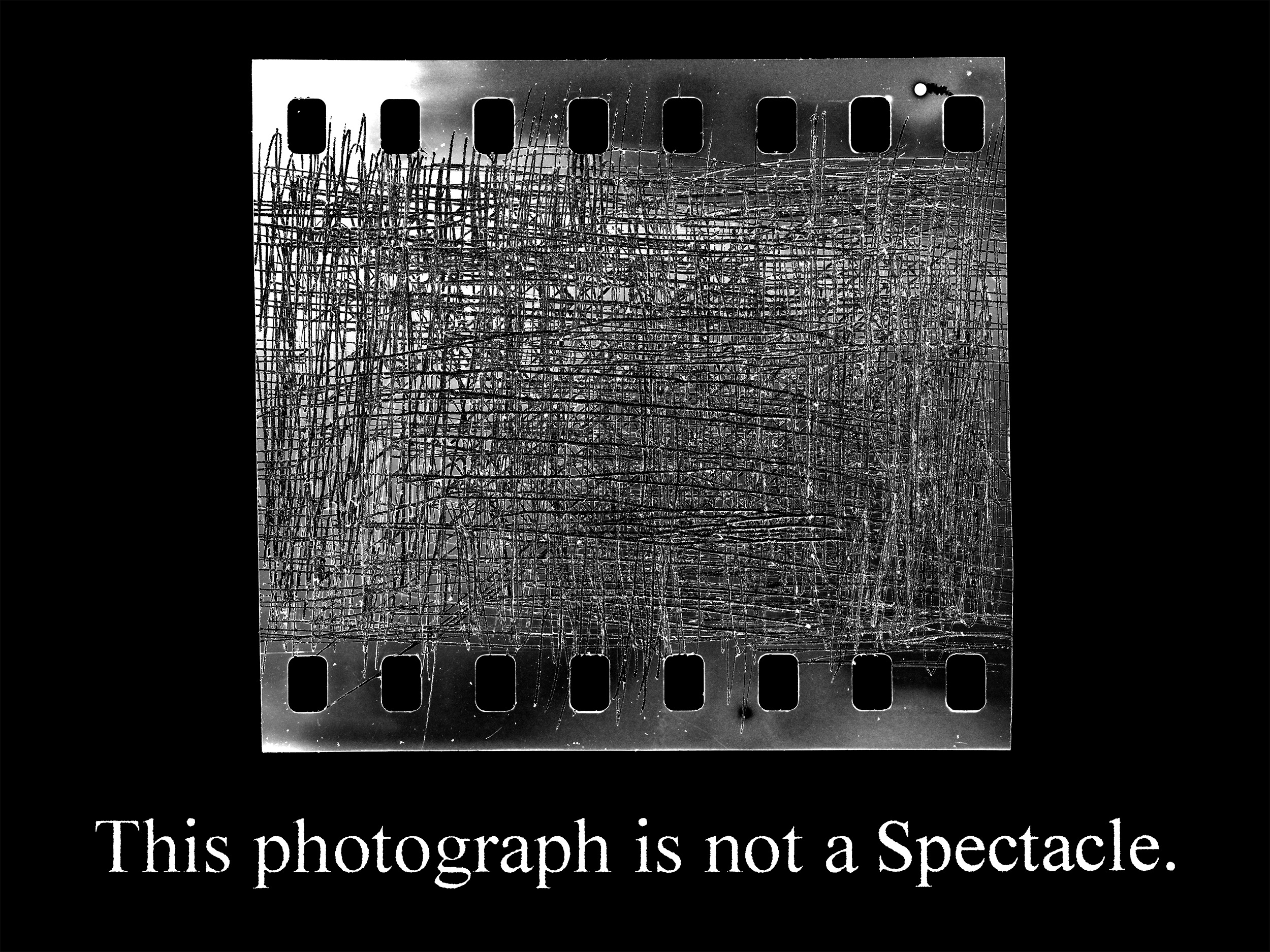
 The Treachery of Spectacles
Scanograph
When all photos have already been taken, and all images have become accessible -- any photos yet to
be taken can be instantly machine-made -- does this mean that photography has died and become
obsolete?
According to Guy Debord’s The Society of the Spectacle, we all live in a society driven by
images and representations. In layman’s terms, the Spectacle consists of systems of representations
through media and economy, and the dictation they have over the inner workings of our capital-driven
society. When all of our commodified images have been diluted to no longer represent any semblance
of truth -- i.e. images made by AI overtaking the number of images captured by camera -- we will
have progressed to a different state of society. In this society, the Spectacle has more prevalence
than reality itself.
For instance, photographs of deceased loved ones can now be generated by a machine. You can even use
the machine to speak with said loved ones from beyond the grave. If the machine can flawlessly
regurgitate their representation (and likeness), why would you even need to keep photographs of
them? AI-generated illusions would be more fulfilling than photographs based in reality.
In our current state of technology, people may AI-generate themselves on leisure so that they can
appear sociable and likeable. Netizens may depict themselves enjoying art at museums, enjoying food
at a fancy restaurant, and working out at the gym, all with the click of a button. Such people may
fulfill the superficial desire to “broadcast themselves” manufactured by social media companies far
more easily now. This may even give them more time to work their dead-end job, so they can pay off
their ever-increasing rent! To be experienced solely through representations would be a life lived
through the Spectacle.
The Spectacle will reach a new form when it no longer needs to be fed inputs by consumers (such as
photography) to exist. Mega-corporations will have complete control over the Spectacle by
eliminating the creative whom might act in opposition. If artists were to create work that
commentates on the Spectacle, it would be participating in the same system of mass media as all
other images. Therefore, this type of art is part of the Spectacle. But an image or graphic that
draws attention to the Spectacle may also be an act of anarchy; to liberate society from the
spectacle would mean disrupting the influence of the image world. This would entail a form of
post-photographic art. This form of art has been around as long as images have existed, but it has
yet to be actualized into a concise art movement. As artificial-intelligence empowers the Spectacle,
the desire for a movement will rise in response.
The Treachery of Spectacles is a graphic persisting of a film photograph and a statement. The artist
has scratched out the film photograph. Underneath, a statement claims that the above image does not
pertain to the Spectacle. This is because it lacks formal elements that depict representations of
reality. In its own condition -- as a work of art -- the image becomes a Spectacle.
Look away from the Spectacle, look at reality.